An interface for writing blocks of data to a data source. More...
#include <OutputStream.h>
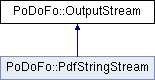
Inheritance diagram for PoDoFo::OutputStream:
Public Member Functions | |
| void | Write (char ch) |
| Write the character in the device. | |
| void | Write (const std::string_view &view) |
| Write the view to the OutputStream. | |
| void | Write (const char *buffer, size_t size) |
| Write data to the output stream. | |
| void | Flush () |
Protected Member Functions | |
| virtual void | writeBuffer (const char *buffer, size_t size)=0 |
| virtual void | flush () |
| virtual void | checkWrite () const |
| Optional checks before writing By default does nothing. | |
| void | enableWriteWindow (char *cur, char *end) |
| Enable the inline write window over the supplied memory region. | |
| void | disableWriteWindow () |
| Disarm the window, once its pending bytes have been handed to the sink. | |
Static Protected Member Functions | |
| static void | WriteBuffer (OutputStream &stream, const char *buffer, size_t size) |
| Write to another stream, skipping its checkWrite() but still serving its inline write window. | |
| static void | Flush (OutputStream &stream) |
Protected Attributes | |
| char * | m_wcur |
| Inline write window over memory owned by the implementation, mirroring InputStream's read window. | |
| char * | m_wend |
Detailed Description
An interface for writing blocks of data to a data source.
Member Function Documentation
◆ disableWriteWindow()
|
protected |
Disarm the window, once its pending bytes have been handed to the sink.
- Remarks
- An arming implementation must call this from its own destructor, after the final drain, as ~OutputStream() asserts the window is disarmed
◆ enableWriteWindow()
Enable the inline write window over the supplied memory region.
- Remarks
- Must be armed only once write access is granted, since the fast paths skip checkWrite()
◆ Write() [1/3]
| PODOFO_INLINE void OutputStream::Write | ( | char | ch | ) |
Write the character in the device.
- Parameters
-
ch the character to write
◆ Write() [2/3]
| PODOFO_INLINE void OutputStream::Write | ( | const char * | buffer, |
| size_t | size | ||
| ) |
Write data to the output stream.
- Parameters
-
buffer the data is read from this buffer size the size of the buffer
◆ Write() [3/3]
Write the view to the OutputStream.
- Parameters
-
view the view to be written
Member Data Documentation
◆ m_wcur
|
protected |
Inline write window over memory owned by the implementation, mirroring InputStream's read window.
It has three states:
- unarmed: m_wend == nullptr, every write takes the virtual slow path
- armed, full: m_wend != nullptr && m_wcur == m_wend, no room left
- armed, with room: m_wcur < m_wend, writes are served by the window Unlike the read window, which can be dropped at any time, the bytes before m_wcur are pending output: an arming implementation must keep them ahead of what writeBuffer() receives, and hand them to its sink in flush() and in its own destructor While armed, writes served by the window never reach writeBuffer(), so an implementation that counts or inspects bytes there must derive the count from m_wcur instead, or not arm at all
The documentation for this class was generated from the following files:
- src/podofo/auxiliary/OutputStream.h
- src/podofo/auxiliary/OutputStream.cpp